North Korea
Winter in SokchoNorth Korea is both a neighboring country and an obstructed presence in the narrator’s life on the coast of South Korea. From the beaches near Sokcho, the border is less than sixty kilometres away, yet reaching an observation point requires permission, a prescribed route, and a visit conducted under surveillance. The novel presents North Korea through this gap between proximity and access: as a view blurred by weather, a history mediated by a museum, and a continuing threat that makes the local landscape feel unfinished.
Geography and the coastal boundary
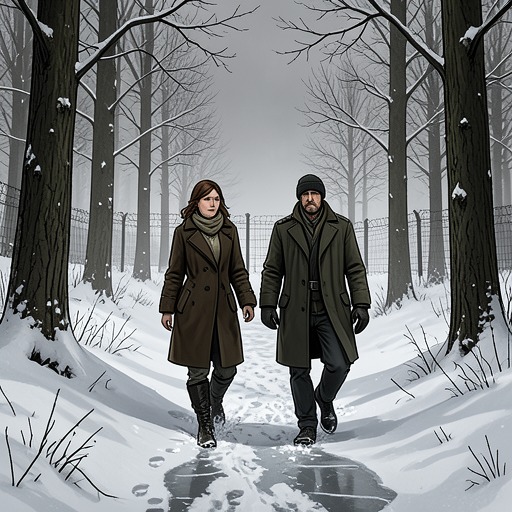
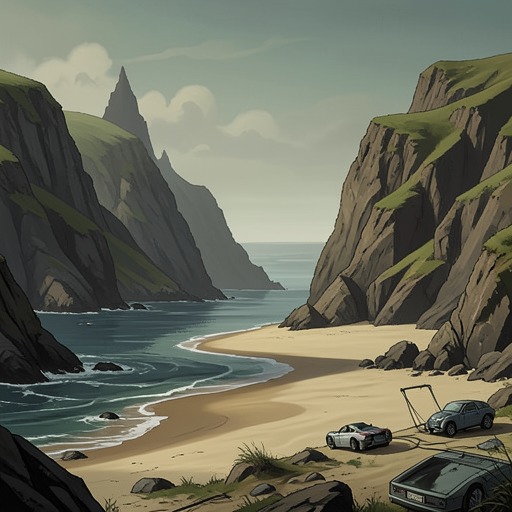
The narrator’s attachment to the coastline is inseparable from its electrified barbed-wire fence. The wire runs along beaches that might otherwise be experienced simply as a stretch of shore; instead, it marks the border’s intrusion into ordinary scenery. The narrator calls the coast beautiful while acknowledging its scars, placing the border not at a distant line on a map but beside the water and the town’s daily landscape.
The journey inland makes that proximity concrete. On the road through Gangwon Province, the narrator and Yan Kerrand pass the remains of villages, discarded materials, and metal sheets. The narrator describes the province as having been left to decay since the Korean War. The landscape does not offer a clean transition from inhabited South Korea to an abstract military zone: damaged settlements and the road itself carry traces of the conflict before the travellers reach the checkpoint.
The controlled journey to the observation point
Kerrand asks to visit the North Korean border, but the bus only reaches a vehicle checkpoint. The observation point lies in no man’s land and requires a private car. Kerrand has a French licence but not the international licence the rental agency requires, so the narrator offers to drive him. Their visit is therefore enabled by the narrator’s practical involvement as well as by the formal arrangements of the tour.
At the checkpoint, a young soldier makes them complete forms while a loudspeaker repeats restrictions: no photography or filming, no leaving the marked path, and no loud voices or laughter. After the soldier returns their papers and salutes, the fence opens onto the restricted zone. An armed convoy escorts them at first, then turns away, leaving the two visitors alone on the road. The observation point is two kilometres ahead, reached between snow-filled ditches. The prohibitions and escort establish the border as a place where movement is permitted only within set limits, even for visitors who have come specifically to look.
A woman in a pink jacket stands beside the road. Kerrand brakes, apparently thinking she is about to cross, and signals for her to do so; she remains still, her hands crossed behind her back. As the car moves on, she watches it disappear around a bend. Later, in the car park, the same woman approaches the narrator, speaks to her, and strokes her cheek with a rough hand. The narrator pushes her away; Kerrand calmly puts an arm around the narrator’s shoulders. The encounter offers no explanation of the woman’s presence or intentions. Its unresolved quality echoes the limits of what the travellers can know in a place defined by separation and controlled passage.
Looking across the border
At the lookout, visitors can pay five hundred won to use binoculars. The narrator looks through them in intense cold, but the view is obscured by fog: the ocean lies to one side, a wall of mountains to the other, and ahead there is little to see. The observation point makes looking into North Korea a managed tourist activity, complete with a coin-operated instrument, while the weather frustrates the expectation of a clear view. North Korea is near enough to be the object of the excursion but remains visually inaccessible on this visit.
The museum offers a different kind of access: an official account presented in exhibits and translated by the narrator for Kerrand. Its display describes the Korean War, which began in 1950, and identifies the North’s support from the Soviet Union and China and the South’s from the United States and the United Nations. It records the signing of the Korean Armistice Agreement on 27 July 1953 and the creation of the frontier along the 38th parallel. The border is described as four kilometres wide and 238 kilometres long, among the world’s most heavily militarized, and the display gives an estimate of two to four million military and civilian deaths over the three-year conflict. It also states that no peace treaty has ever been signed.
The account’s scale is set against smaller objects in the same museum. The narrator is drawn to schoolchildren’s shoes from the North and blue-packaged Choco Pies, wondering whether the cakes inside are real or made specially for the exhibit. These details make the neighboring country present through the ordinary things attributed to its children, even as the museum frames those things within a state border and a history of war. Kerrand listens intently while the narrator translates, so the site’s information reaches him through her voice rather than through an unmediated display.
An unfinished war in the present
The border’s presence extends beyond the checkpoint and museum. During a rainstorm, the narrator points out bunkers at regular intervals along the beaches, with sub-machine guns protruding from their openings. The visible military installations interrupt the coastal landscape and complicate Kerrand’s comparison with the beaches of Normandy, which he describes as bearing scars of an earlier war. The narrator distinguishes the two histories: in South Korea, the war has not reached a settled end. Hotels and neon signs may make the coast appear like an ordinary tourist destination, but they do not remove its exposure or the narrator’s sense that the situation could give way.
That sense of danger is grounded in a recent incident the narrator recounts to Kerrand. The previous summer, a tourist from Seoul was shot by a North Korean soldier while swimming in the sea, having failed to realize that she had crossed the border. The episode makes the shoreline’s division more than a historical marker or distant military fact: a swimmer can cross it without recognizing that she has done so, with fatal consequences. North Korea thus remains both a country glimpsed through the apparatus of observation and a force shaping the narrator’s account of a coast where the war’s ending is still awaited.